|
Unintentionally, this is turning into a kind of Ionic Performer documentation page. I'm happy to add more pix and information about the unit. If anyone has contact with the surviving Mayers, I'd be delighted to post some of their own reminiscences. If this page gets too "heavy", I'll start splitting it up. You can find me by filling out this form (it protects me from blatant email harvesting, anyway. On this page: |
|
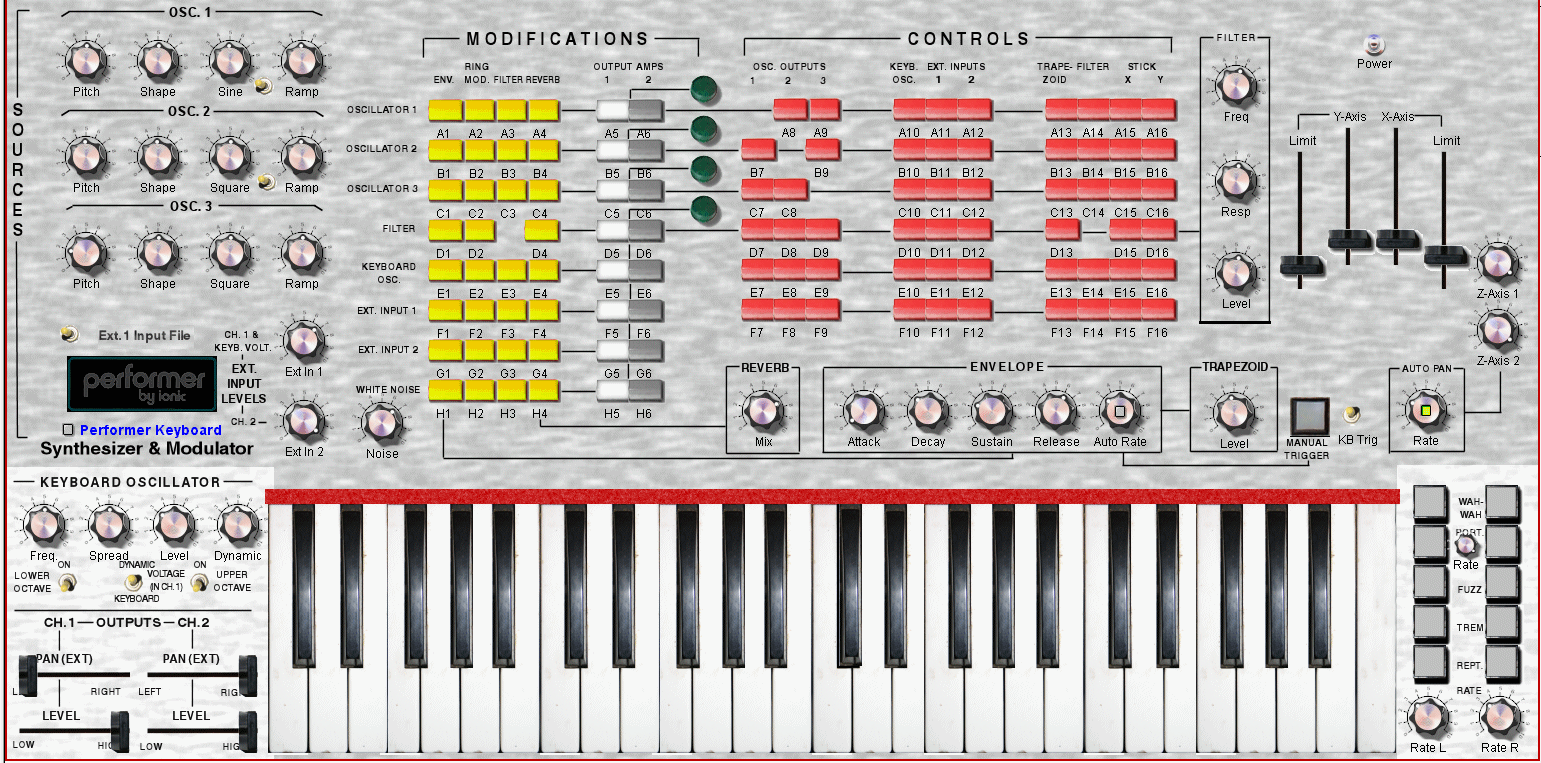
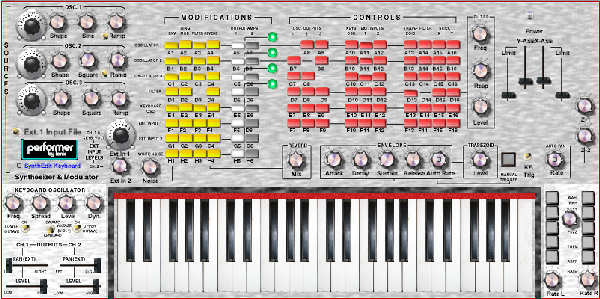
Performer VSTi!Here is a screen shot of the VSTi. Looks pretty good, no? And it all works just as crazily as the hardware version! A new beta is now ready. Yes, it is pretty good. I like it.
|
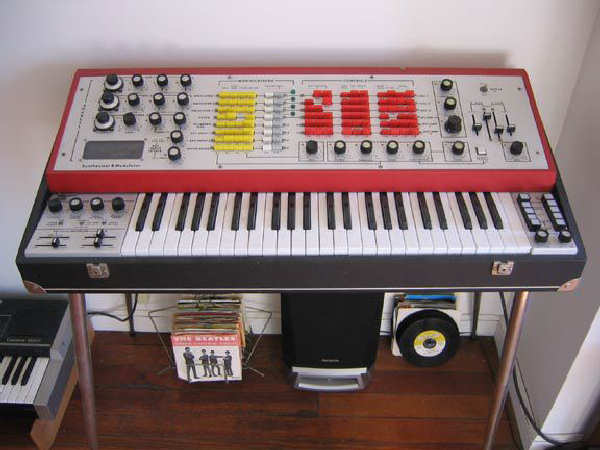
My "Killer" Performer |

|
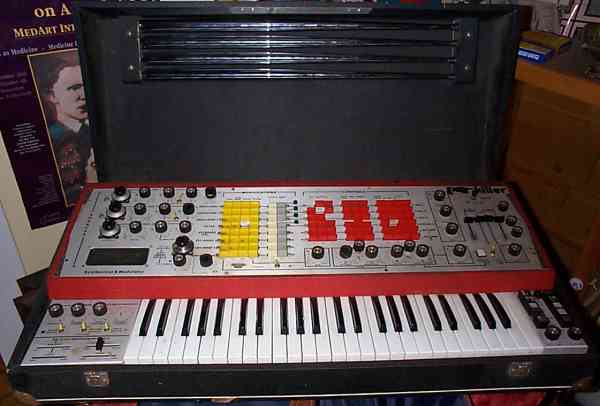
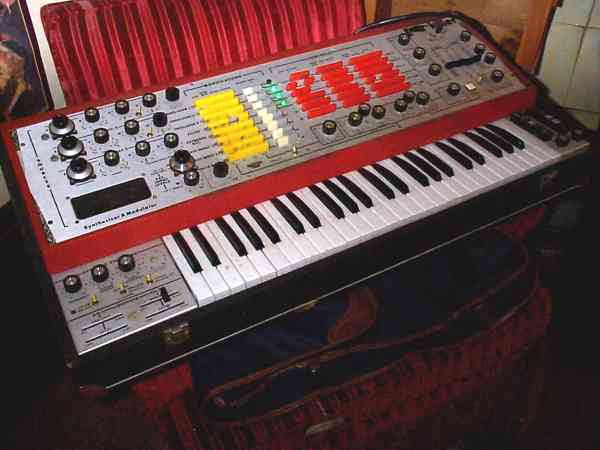
Front view, showing the legs tucked into spring-loaded holders in the top. Clockwise: 49-key keyboard (full-size keys); left block with keyboard oscillator, output volume and pan; oscillator sources; modifications; modification routings; controls and envelope; noise and trigger; axes controls; right block with fuzz, portamento, etc. |

|
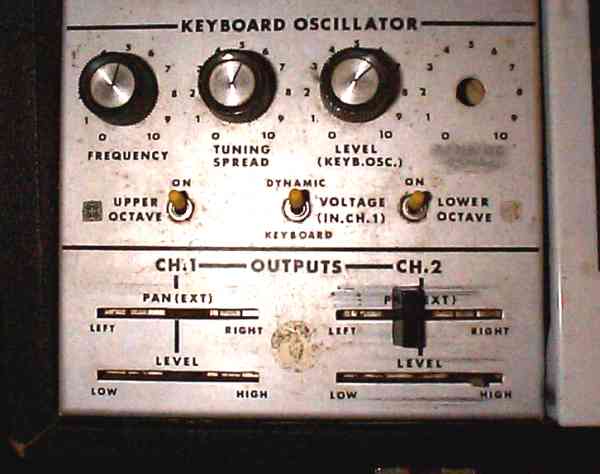
The left block contains the keyboard oscillator - frequency, tuning spread (distance between notes), level, octave divider and doubler, and whether the keyboard dynamics or voltage were routed to the modification rails. Also on the block are the left and right output level controls, and their pan positions (affecting only the line output). The fourth (right-hand) control was supposed to change the dynamic range of the keyboard, but I removed it because it was unworkable and unpredictable on the prototype unit. I can't remember if the production units fixed it or removed it. |

|
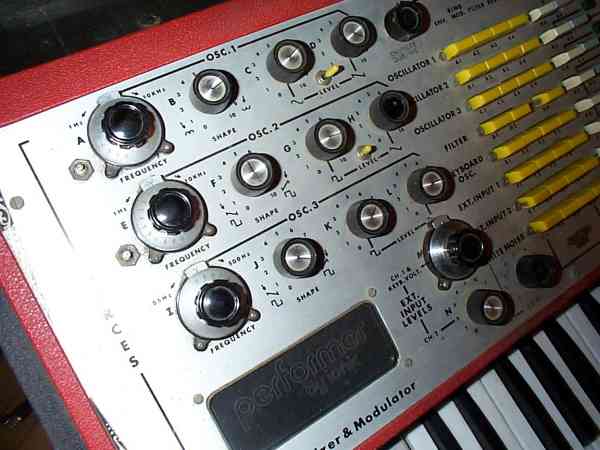
There are two main oscillators (sine/triangle and square/triangle) and one square with an extended low range (to .01 Hz -- a direct-coupled output that caused Killer to regularly blow up my transistorized Dynaco power amps). The shape (duty cycle) is adjustable as is the relative level of the waveform pairs. The two yellow toggle switches are octave dividers added later, and the small nubs to the left of the oscillator levels are tuning spread trimmers. Below is the external input level control (line or microphone could be modified as well as the oscillators) and the routing of the keyboard oscillator as a source. I replaced the voltage source with a finely adjustable control. The last source in the group is white noise, with its level control that I added. |

|
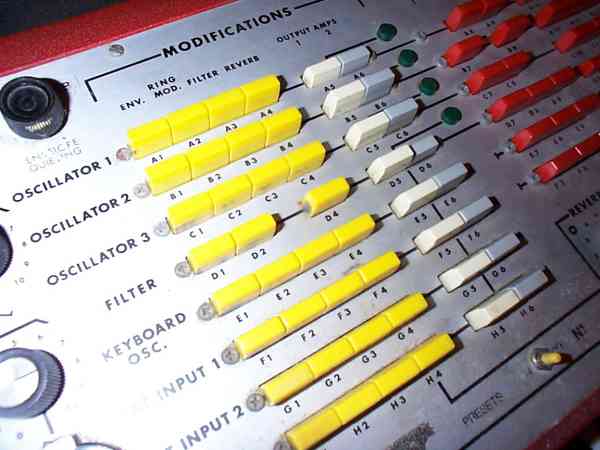
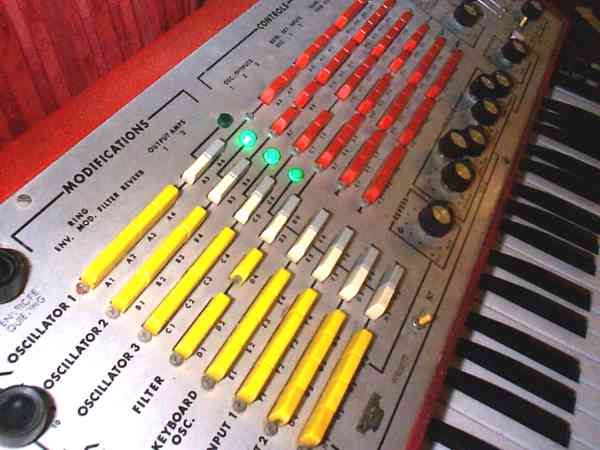
Each source can be modified by an envelope, ring modulator (modulated from any other source), filter, and reverb, and be routed to either or both output amp directly. Note that the filter (either with modified output or ringing at the Q point) could also be a source, as well as the keyboard oscillator, external inputs, and white noise. To make sure the player knew which oscillators were in use, there are four green lights (one for the oscillators, one for any other source). To the bottom is a presets switch added later, which was used to turn on or off the right-hand keyboard block (fuzz, portamento, etc.). Because that block was noisy, I took it out of circuit with this switch. Another control I added was envelope quieting (at the top). The envelope "off" state was very sensitive to temperature changes (and got worse over time), so this control trimmed it to silence. |

|
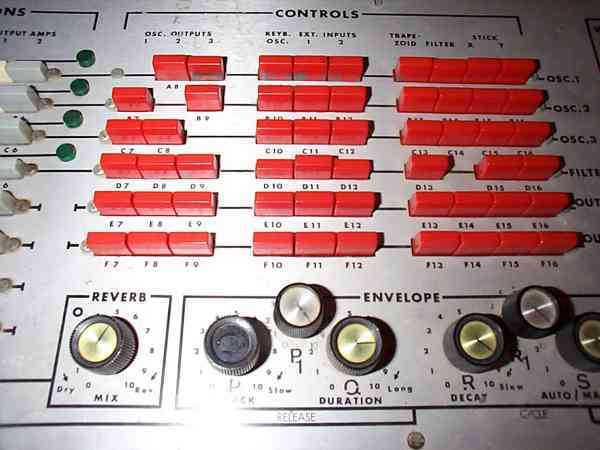
Beginning at the bottom is the reverb (spring reverb), with a nice, rich dry/wet mix. To the right is an Attack/Duration/Decay envelope, which I later modified to Attack/Decay/Duration/Release envelope with a cycle control -- this is way pre-digital! The automatic envelope trigger control is to the right (almost out of the photo). The switches at the top patch the output of one device to the input of another. Only the oscillators and filter can't be patched to themselves, and the white noise has no input. But you could create some pretty unbelievable sounds with this matrix! Note the three items first introduced here, the trapezoid controller (actually the envelope used as a voltage source) and the two "sticks" (pseudo-joysticks). |

|
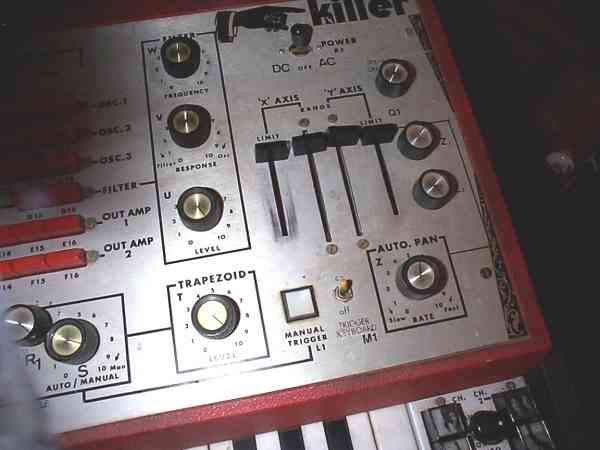
The filter allows adjustment of frequency, response (Q, right to the feedback point so it could be used as another oscillator), and output level. The trapezoid (envelope) level is also adjustable. The "sticks" adjust two "axes" -- assignable to any device, and adjustable (using the two limit sliders) from no effect to full range. The sticks make this one heck of a microtonal machine. The system is +/-18 volts, so the limit range is extensive. Power and speaker on/off switches are at the top. To the right is the "Z axis" (auto pan/phase) pullswitch and level control, with my added controls to allow the pan to be placed anywhere in the soundstage. A manual envelope trigger is available, and trigger was normally routed to the keyboard in every case; I made this optional with a keyboard trigger switch. |

|
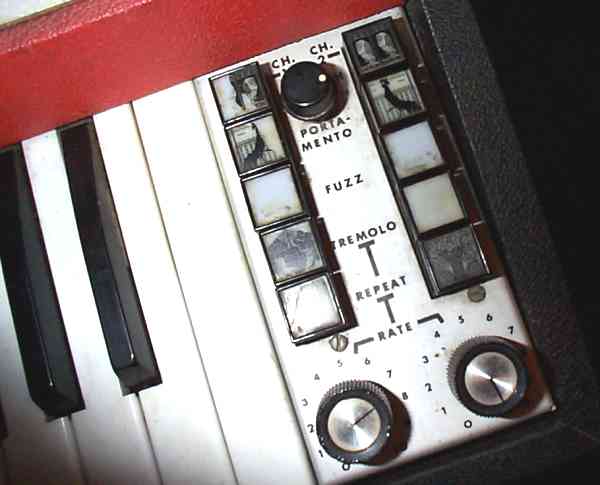
The right keyboard block controls final output functions. The two channels can be assigned portamento (which worked quite well) with adjustable pitch slide speed that makes Midi look positively amateur, fuzz (which I later replaced with a fuzzier circuit of my own design), tremolo (triangle controller) and repeat (square controller). The latter two could be given a different variable rate for each channel, and combined with the Z-axis auto-pan, zowdy! These buttons were originally intended to be illuminated, but the lights drew too much current; I later added low-current lights. Also, I added a switch to take this block out of circuit except when needed because it was noisy. All the funky decals on the machine are from Letraset stick-ons. |

|
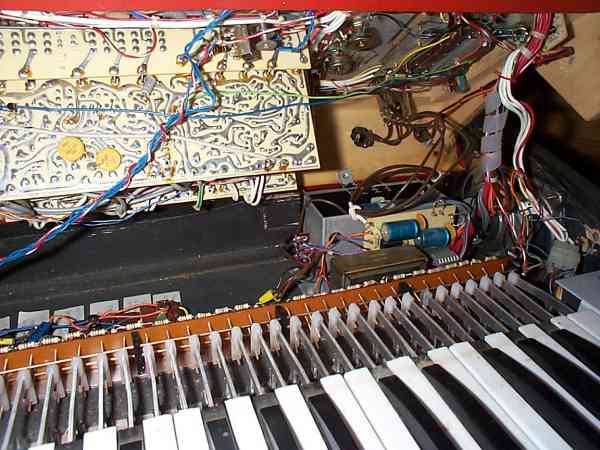
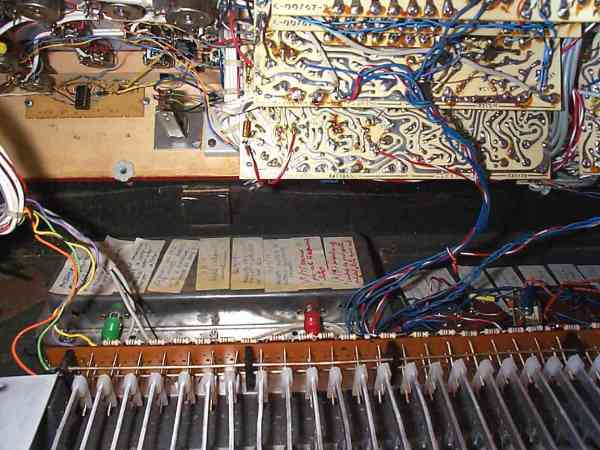
Inside on the right shows the double-rail keyboard which determined dynamic from the time difference between striking the top and bottom rails, and divided the voltage with precision resistors. The LM550-controller power supply is at the back, a high-current baby which ran the output ampliers to the high-efficiency speakers (one is just visible behind the wiring harness at the right). This is a self-contained performance keyboard, with hi-fi stereo output from the case sides. All the circuit boards are phenolic and noisy. Lots of transistors needed replacement, too ... the circuits were all designed around discrete parts, as monolithic op amps were new and expensive. The boards were fairly easy to get at and fix or modify, and fortunately, the designers marked the purpose of each section of circuit right on the boards. |

|
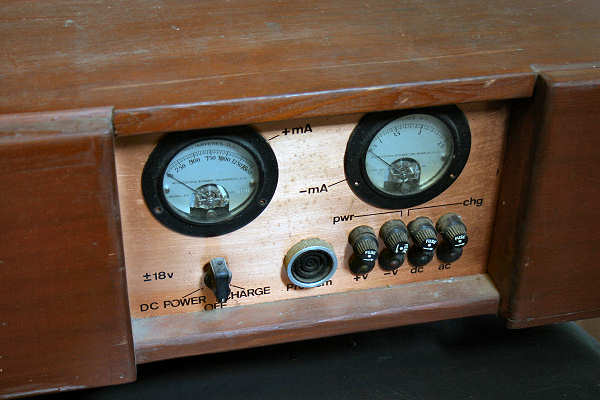
Inside on the left shows the spring reverb (this is a later replacement, a higher-quality unit) covered in labels with notes describing my obsessive modifications. To the back the digital octave divider modification can be seen. The back panel (not shown) had left and right speaker and line outputs, line and mic inputs, stereo headphone output, and trigger and voltage inputs. I also added a +/-18v input connector for outdoor use with motorcycle batteries (in a handmade redwood case with Nice Big Black Meters). Killer was used for the 1975 premiere of Invocation, Dance and Lament for Twandano with dancer Reuben James Christian Edinger, the first performance at Pepsico's sculpture garden before it became a hip venue. |

|
Killer is a surprisingly performable instrument. The designers had ergonomics down before IBM invented the term. Color-coding and logical layout made the instrument performable in near-darkness, and in fact I used it in the New Jersey State Museum Planetarium for the live version of Somnambula for recorder and synthesizer (with the green lights taped over with black electrical tape). I printed and bound books of blank layout sheets so that I could switch settings on the fly during a show. Both Killer and David Gunn's Astrosynarce (an unmodified Performer synth made as part of Ionic's small production run) were used in David's Boondock and my Rando's Poetic License, as well as many other performances from 1974-1982. The machines were then retired. |

|
It's a beauty. And it still works! Killer was used not only in the pieces mentioned above, but also in Transresistor (1973), The Development of the Consciousness of Space in a Child and Five Daydreams (two half-hour pieces) and Bomber (1974), Song from Isaiah, three versions of Network C/R, and ...and gently lead (1975), Wedding Music (1981), Bugs (1982), and many improvisations and shows, including a series with poet Gerald Pitt. Say, do you covet this Killer? You can have it -- for 10 times what I paid for it. |
Other Surviving Performers! |


|
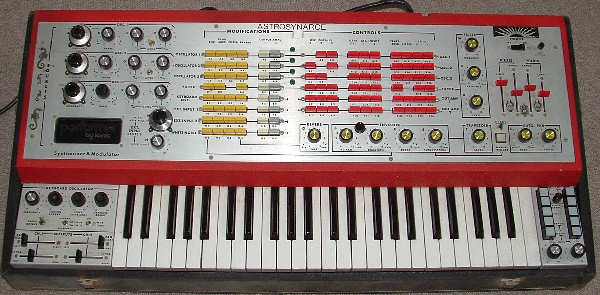
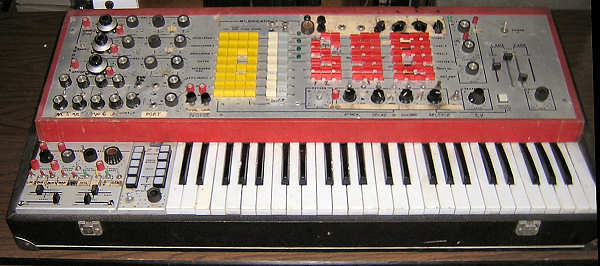
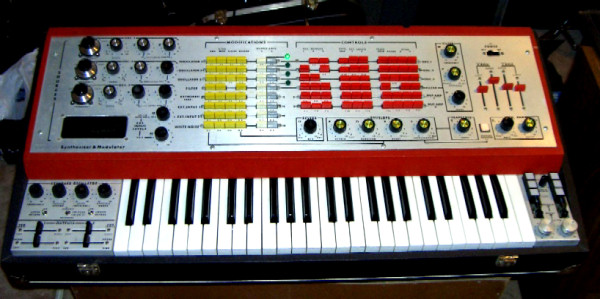
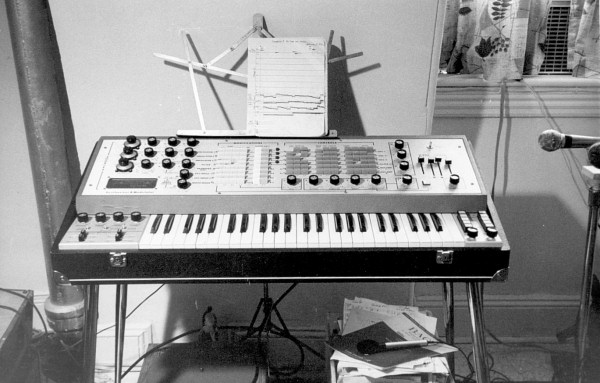
Three more Ionic Performers. David Gunn's the top photo, with some of my modifications (the oscillator octave switches, additional envelope control, trigger switch) and some of his decorations. The one below it belongs to a musician in New York who will have the unit for sale once it's repaired; his unit, save for a few lost knobs and knob inserts, is pristine. And the bottom is the most heavily modified unit I've ever seen, owned by John King. John writes about Alfred Mayer and buying and modifying his Performer. Independently John and I had both seen the prototype sequencers in action, and hoped to buy them if they ever got produced:
|
Memorabilia and Other Stuff! |
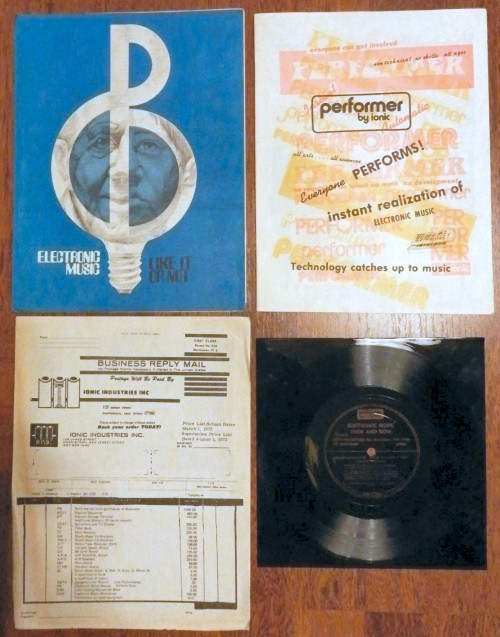
(Click the image below for a 50MB PDF copy.) I have attempted to reach the surviving Mayer family to obtain formal permission to reprint this material, but without success. I have heard from a teeange grandson, but not yet from any members of the family who may have an interest in this material. Please contact me if you are an heir to these copyrights.
|
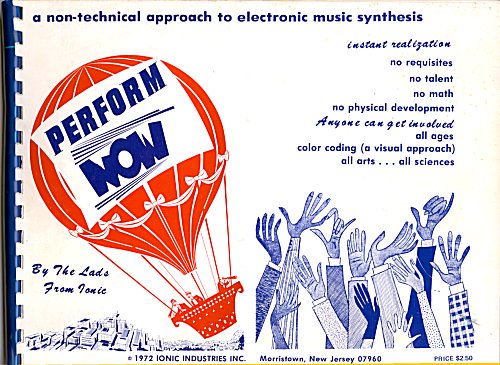
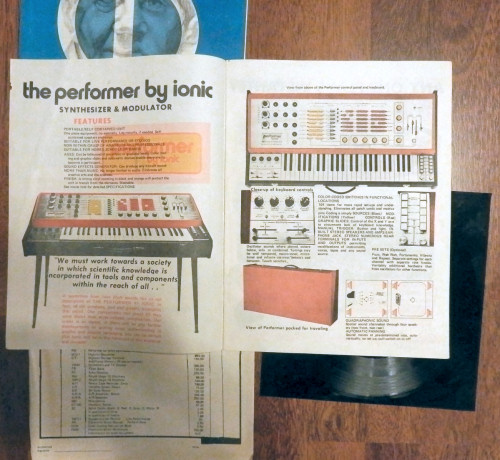
The Performer manual is a monument to publishing kitsch. The cover only gives a hint of the hideous design inside. But no matter. The simplicity of the manual and its repetitive images of The Performer on every page were exactly what was needed to make use of the instrument easy and immediate. Alfred Mayer wrote this manual and Electronic Music for the Seventies (below) and designed the look and feel of The Performer and (if I recall correctly) with his son designed the instrument. He was a gentleman, and his showroom, design studio, and testing grounds were in the basement of his home in Morristown, New Jersey. I fell in love with the instrument on the spot, and took out a bank loan to buy it the next week. |

|
Electronic Music for the Seventies has The Putney on the cover. Inside is a dense explanation of complex, analog electronic music production of the day, and tools and techniques for using The Putney to create sounds. Although this wonderful and curious little instrument was featured in the Whole Earth Catalog, it never took off. Mayer turned around and designed The Performer (in this case much too far ahead of its time) which was, of course, an economic failure. I don't know how many were made, and would love to know what happened to Alfred Mayer and his forward-looking Ionic Industries. |

|
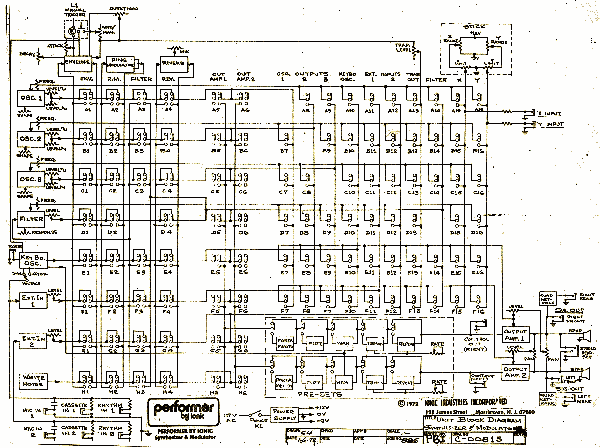
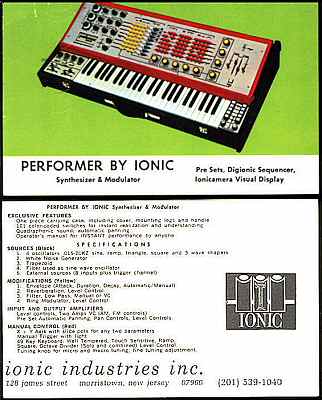
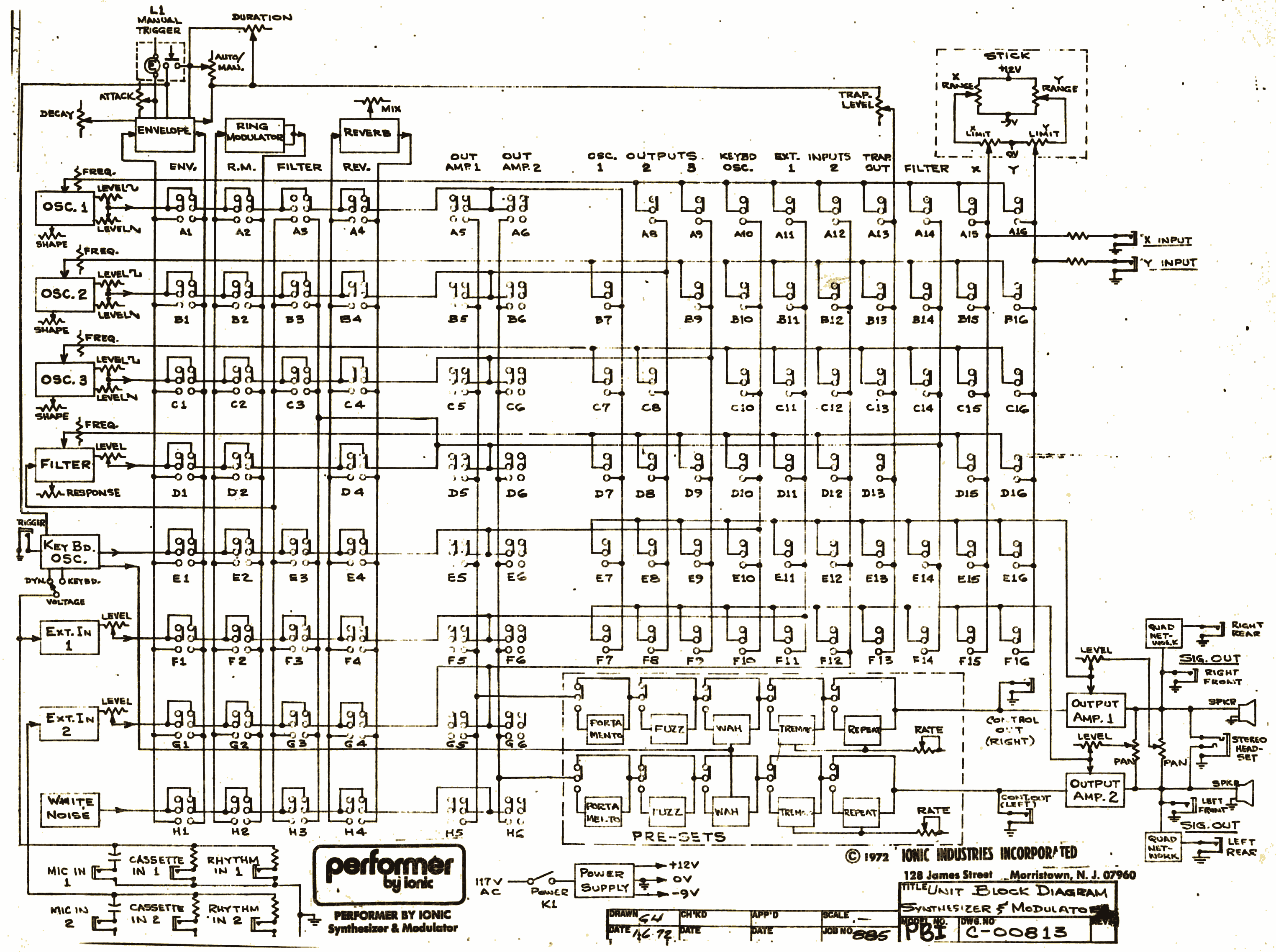
David Gunn found the original block diagram for the Performer Ionic, along with some tip sheets. The block diagram is above and this is a full-size printable version. |
![]()
|
|
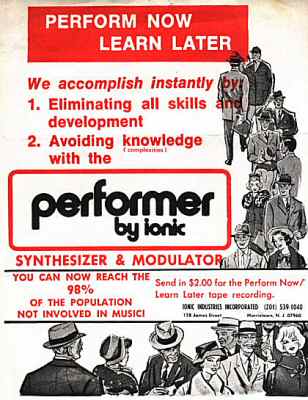
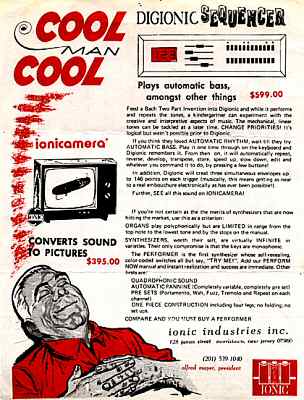
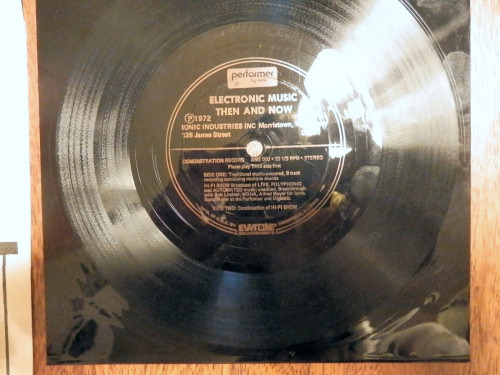
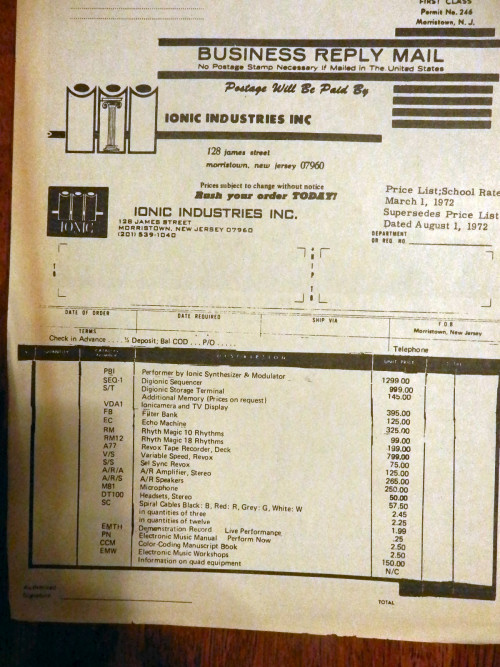
Other Memorabilia. These discoveries courtesy Brian Kehew, who calls this "my dream synth". |
|
|
DC Power Supply. This supply, housed in redwood, was built & used by me (as the character "Twandano") with Ruben James Christman Edinger at the Pepsico sculpture gardens for his music-dance piece Sunrose in 1975. |
![]()
![]()
|
|
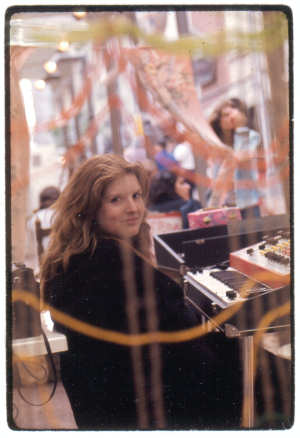
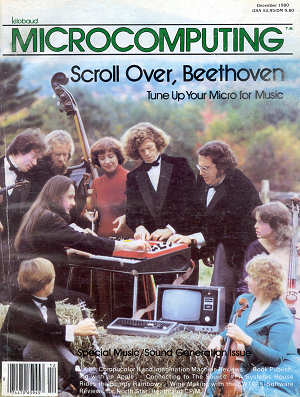
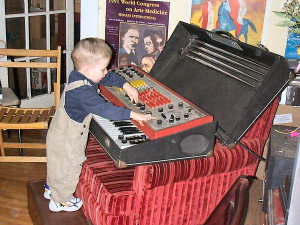
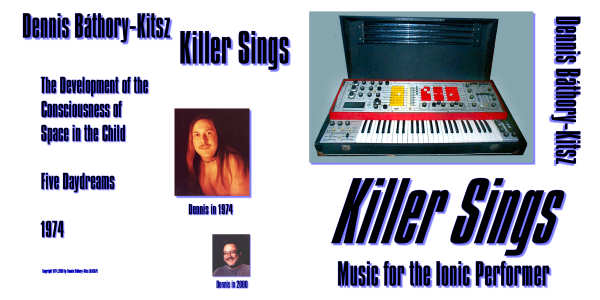
Other Appearances. (Top row) At the Delaware Valley Festival of the Avant-Garde 1974; Kilobaud Microcomputing Cover, 1980 -- that's me with the long hair. (Next row) Battle of the Synthesizers Advertisement, 1977, with David Gunn being speared; 2-year-old Justin plays Killer, 2002. (Bottom row) Killer Sings CD, 1974 pieces reissued in 2002, available from me. |

|
Upcoming. Pix, schematics, and software that ran my original 1978 TRS-80 interface to Killer! I will post these as soon as I can. |
|
This gentleman went on in several emails... amazing how overwrought someone can be about a 30-year-old piece of equipment! In any case, borrowing and outright design copying were rampant in those days before copyrights and patents were easily extensible into the smallest of implementations. The defense of the EMS backward-looking product gives no credit to the true innovation of the Ionic Performer -- interface design, which foreshadowed every synth of the next three decades.
The following from Tristram Cary was posted in response to comments on the list CEC-Conference:
The following from Robin Wood was also posted in response to comments on the list CEC-Conference:
Most interesting to me is that the pushbutton, integrated-keyboard, effects-tailed "no talent" design of the Performer was ultimately the direction of electronic music instruments for the following 30 years. The circuitry was the least significant part -- so I reiterate that it was the ergonomics that mattered, despite the crybabies. Mayer had it right. So that's all for now. Please share your images & music made on the Ionic if you'd like to do that! |
Page maintained by Dennis Bathory-Kitsz, Contact Form.